

Grinder Pump Alarm Going Off? What to Do in Myrtle Beach and Horry County
Grinder pump alarm going off? What it means, the first steps, GSWSA's power outage advice and who to call in Myrtle Beach and Horry County.
Photo: Jung Pumpen GmbH, CC BY-SA 4.0, via Wikimedia Commons
A grinder pump alarm means wastewater in the pump’s tank has reached the high-level mark, usually because the pump has stopped or can’t keep up. Stop using water, check the breaker and wait a few minutes; if the alarm stays on, call your utility or HOA if they maintain the unit, or Myrtle Beach Sewer Line Repair anywhere in Myrtle Beach, Conway and Horry County.
Call (843) 429-6659 when a grinder pump alarm won’t clear.
Call nowWhat does a grinder pump alarm mean?
It means the tank is nearly full. Environment One (E/One), whose units GSWSA’s storm guidance names as its example, says the alarm sounds when wastewater reaches a set level, and that a pump that stops working makes the panel’s red light blink and a buzzer sound.
The pump grinds everything the house drains into the tank and pushes it through a small pressure line to the sewer main, typically 20 to 40 times a day for a minute or two, according to E/One. GSWSA puts a typical home unit at about 70 gallons, and the alarm sits above the normal pumping level, so once it sounds, the space left is your margin before sewage reaches the lowest drain in the house. Some homes that moved from septic to sewer use grinder pumps, as our guide to septic vs sewer in Horry County explains.
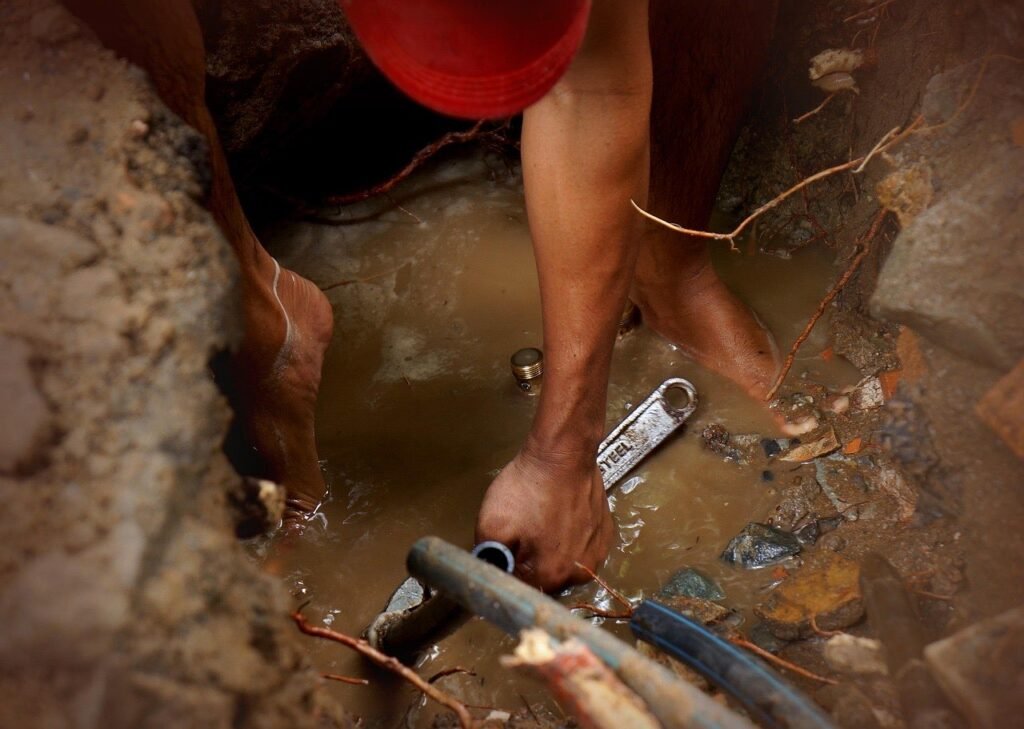
Grinder pump alarm going off? Do this first
Stop using water, wait a few minutes and check the breaker; if the alarm doesn’t clear, call.
- Stop using water. No laundry, dishwasher, showers or baths, and flush only when you must. E/One’s instructions say water use has to stay within the tank’s reserve capacity until a technician arrives.
- Silence the horn, not the problem. The silence button is on the alarm panel, often underneath. A homeowner manual for E/One pumps notes that the light stays lit, and E/One warns never to silence the alarm and keep using water while the pump isn’t working.
- Wait a few minutes. A big tub draining or back-to-back laundry can outrun the pump. E/One says an alarm that clears within minutes and stays off usually means the pump is fine.
- Check the breakers. A standard E/One installation has its own 240-volt breaker of at least 30 amps in the house panel, and E/One alarm panels have pump and alarm breakers inside. Reset a tripped breaker once; if it trips again, leave it off. Skip this if anything is wet, and leave a locked panel locked.
- Leave the tank and wiring alone. The tank holds raw sewage and sewer gas, and the panel carries 240 volts. Lids, pumps and panel wiring are for a trained technician.
- Call if it won’t clear. An alarm that stays on or keeps returning needs service.
Why is my grinder pump alarm going off?
Usually because the pump has stopped or fallen behind a burst of water, and sometimes because the panel has shut it down to protect it.
| What the alarm does | Likely cause | What to do |
|---|---|---|
| Clears within minutes after a big drain | The tank filled faster than the pump could empty it | Spread out laundry and baths |
| Sounds right after the power returns | The pump is catching up after the outage | Keep water use low; call if it doesn’t clear |
| Stays on | The pump has stopped: a tripped breaker, a jam or a failed part | Stop water use, check the breaker, call |
| Comes and goes in normal use | A pump or control that needs service | Book service before it quits |
| Silent, but drains are slow or gurgling | A clog before the tank, or a failed alarm | Book a camera inspection |
Grinder pump not working: common causes
Most failures trace back to power, what goes down the drains, or wear.
- Power. A tripped breaker, an outage or low voltage. E/One’s Protect Plus panels stop the pump temporarily during brownouts, run-dry conditions and high pressure, such as a closed valve in the discharge line.
- Wipes and grease. E/One says wipes labeled flushable still don’t break down in water, and a garbage disposal doesn’t keep grease out of the system.
- Sand and grit. Sand, aquarium gravel and kitty litter are on E/One’s avoid list, so rinse beach gear outside.
- Worn parts. Pumps and level controls wear out; E/One treats frequent alarms during normal use as a sign that service is due.
- A clog before the tank. A blockage between the house and the tank backs up drains without tripping the alarm, because the tank never fills. That pipe is repaired like any other; see sewer line repair in Myrtle Beach.

Grinder pump alarm during a power outage
Without power the pump can’t empty the tank, but your water may keep running, so every flush adds to a tank with nowhere to send it. GSWSA says a typical home unit holds about 70 gallons and asks owners on individual pumping units to limit water use until power returns, warning that an outage raises the chance of sewage backing up into the home.
Hurricane season here runs June 1 to November 30, and GSWSA’s storm advice for every home is to flush only when necessary until services are restored. To stretch those 70 gallons:
- Skip the washer and dishwasher. If someone must wash, plug the tub and drain it after power returns.
- Don’t wait for the alarm; a standard panel shares the pump’s power and may stay silent.
- When power returns, the alarm may sound while the pump catches up; E/One says to call if it doesn’t clear within a few minutes.
- Run a generator only through a connection installed for the pump, outdoors, and never backfeed through an outlet.
- Stay away from a flooded tank or panel, and never touch a breaker while standing in water.
More storm prep is in our guide to flood sewer backups.
Who to call when the alarm won’t stop
Start with whoever maintains the pump; with sewage in the house, call your sewer utility first.
E/One tells owners to ask the local sewer department whether the utility or the homeowner owns and maintains the pump. Locally, GSWSA’s standards include residential grinder pump stations and STEP systems, the City of Myrtle Beach installed grinder stations for its Briarcliffe Acres sewer district, and GCWSD’s Service Line Protection Program in Murrells Inlet excludes private grinders. None of that settles who owns yours, so ask your utility, check your HOA documents and look for a service sticker on the alarm panel, where E/One says the service number usually goes.
| Situation | Call first |
|---|---|
| Sewage coming up a drain, GSWSA area | GSWSA: (843) 234-8460, after hours (843) 443-8200 |
| Sewage coming up a drain, city utility or Murrells Inlet | The utility on your bill (GCWSD in Murrells Inlet) |
| Utility or HOA maintains the pump | The panel sticker number, or your HOA |
| The pump and lines are yours | Myrtle Beach Sewer Line Repair, (843) 429-6659 |
GSWSA’s rule is “Call GSWSA before you call your plumber,” and it investigates backups at any hour, at no charge. When the problem is yours, we find out whether it’s the pump, its controls or the pipe (with a camera, when drains are backing up) and give you a written, itemized quote before work starts. Angi’s January 2025 cost guide puts grinder pump installation at $2,000 to $4,000 nationally, E/One calls pump life expectancy “difficult to pinpoint,” and we found no published repair figure. Active sewage backups go to the front of our schedule. See grinder pump repair, or emergency sewer repair when sewage is already in the house.
What not to flush with a grinder pump
Only water, regular toilet paper and human waste belong in the drains, E/One says, and its FAQ and user instructions list what to keep out:
- Wipes (flushable ones too), sponges, diapers, socks, rags and cloth
- Sanitary products, cotton swabs, dental floss and syringes
- Glass, metal, plastic objects and disposable toothbrushes
- Seafood shells, cigarette butts, aquarium gravel, kitty litter and sand
- Grease, oil, paint, gasoline, strong chemicals and anything flammable
Before leaving for a few weeks, E/One suggests running clean water into the tank until the pump starts, letting it run until it stops, and leaving the power on.
Grinder pump alarm FAQ
How long can a grinder pump go without power?
There’s no set time. GSWSA says a typical home unit holds about 70 gallons and won’t pump without power, so it lasts only as long as your water use stays under that.
Can I keep using water if I silence the grinder pump alarm?
No. Silencing only quiets the horn; the tank stays nearly full until the pump runs again.
Why does my grinder pump alarm go off after heavy water use?
A full tub or several loads of laundry can outrun the pump. E/One says an alarm that clears within minutes and doesn’t return is usually harmless; frequent alarms mean the pump needs service.
Who is responsible for a grinder pump in Horry County?
It depends on your utility and development. Ask GSWSA or your city, and check your HOA documents and the alarm panel’s service sticker.
Is a grinder pump alarm an emergency?
Yes, if sewage is coming up a drain: stop all water use and call your sewer utility, then us if the problem is on your side. An alarm that cleared on its own can wait for a service call.
Keep reading
Related guides
Backwater Valve Installation in Myrtle Beach: Do You Need One?
What a backwater valve does, when South Carolina’s code requires one, slab vs elevated homes, installation and upkeep.
Read guide
Flood Sewer Backup in Myrtle Beach: Why Storms Push Sewage Into Homes
Flood sewer backup in Myrtle Beach: why storms push sewage into homes, what to do before, during and after, and safe cleanup.
Read guide
Sewer Cleanout Cap: How to Find Your Sewer Cleanout in Myrtle Beach
Sewer cleanout cap: where to find it on a Grand Strand home, what it looks like, how to open it safely and when to add one.
Read guidePhoto credits (Wikimedia Commons): Flood Sewer Backup in Myrtle Beach: Why Storms Push Sewage Into Homes: Senior Airman Megan Floyd/U.S National Guard, public domain.
Sewer or water line trouble?
Call for a camera inspection and a written quote.
Call for grinder pump repair anywhere in Myrtle Beach, Conway and Horry County.

Sewer and water line repair for Myrtle Beach, Conway and Horry County. Camera inspection first, written and itemized quotes, licensed plumbers.
Call (843) 429-6659